
I’ve been on a kick, turning everything into a pretzel. I’ve pretzeled focaccia, cookies, cinnamon rolls, and even pie crust (almost). Now, we have biscuits. Maybe even the easiest ones to pretzel, these buttermilk biscuits get a depth of flavor from the pretzel crust and pair incredibly with my pimento cheese butter. You can also serve them with my honey mustard compound butter. Think of them as the perfect pretzel vessel for whatever delicious compound butter you want to try.
These pretzel biscuits are flaky buttermilk biscuits (my favorite kind) wrapped in in the glossy, deep brown, salty crust of a soft pretzel. One quick brush of food-grade lye (or baking soda, if you would rather skip the lye) before baking is all it takes. The inside stays tender and buttery, and the outside tastes like the best pretzel roll you have ever had.
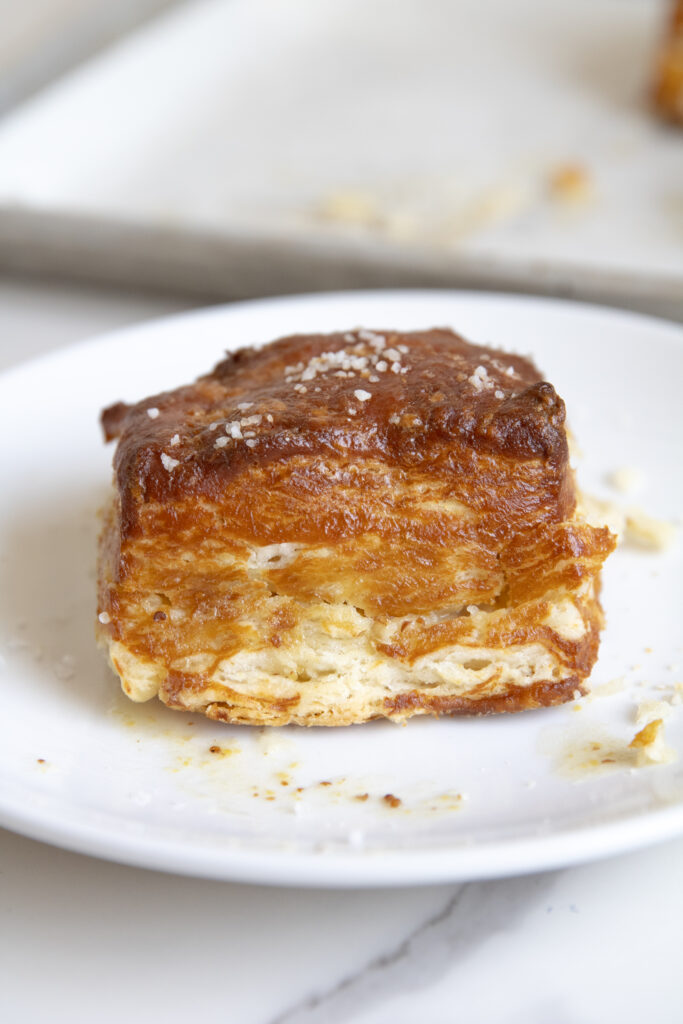
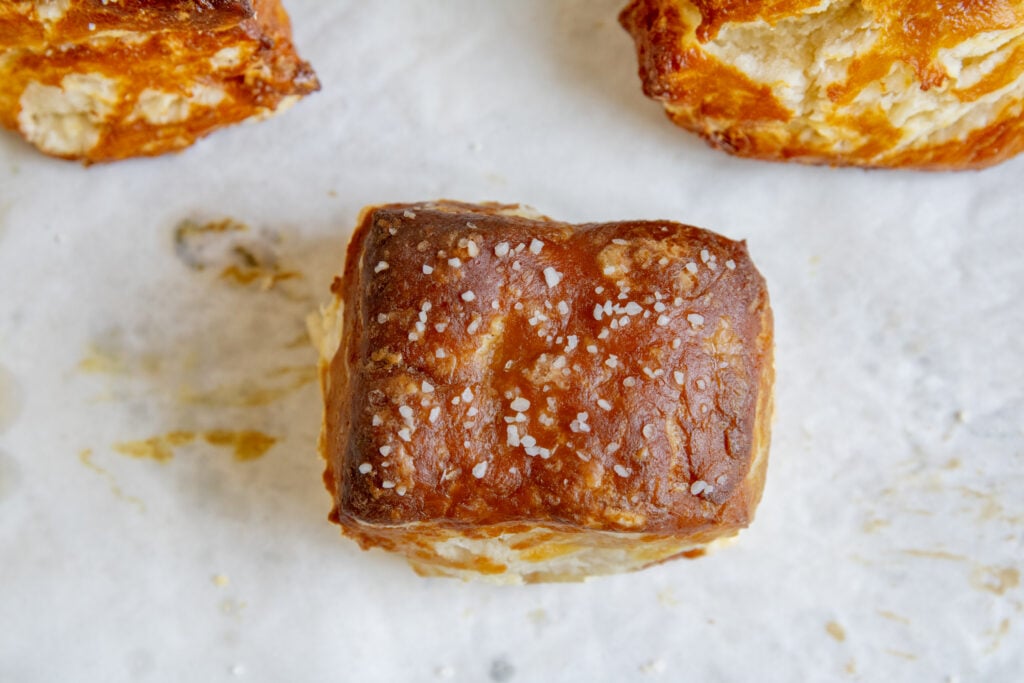
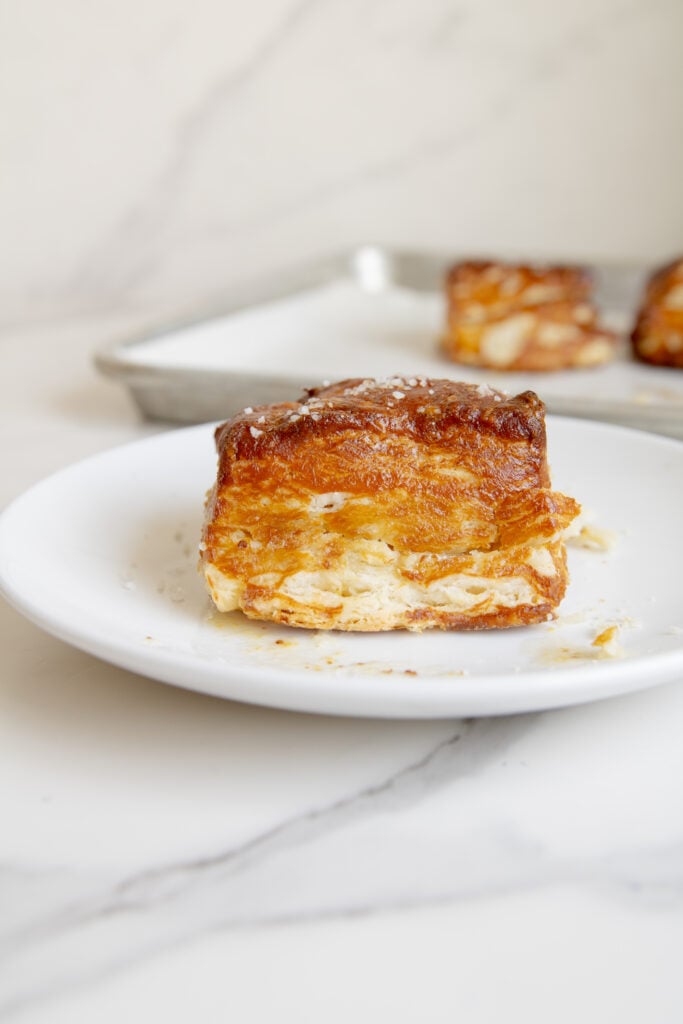
Why you will love these pretzel biscuits
- Real pretzel flavor. Can we make soft pretzels at home? Absolutely. Does this skip the rising, boiling, and rope shaping?? Also, yes. You get pretzel crust on a biscuit you can have in the oven in less than an hour.
- Flaky, pull-apart layers. A few simple folds give you tall biscuits with layers you can peel apart.
- Two methods. Use food-grade lye for the darkest, most authentic pretzel crust, or baking soda for a pantry-friendly version that still gets you close.
What makes a pretzel taste like a pretzel?
Drum roll please, that signature pretzel flavor comes from LYE! If you are thinking “isn’t that what they make soap with?”, well, yes! It may seem strange but traditional German pretzels are dipped in a dilute lye solution (sodium hydroxide) before baking. The high pH does two things on the surface of the dough: it breaks down proteins and starches so they brown much faster through the Maillard reaction, and it gelatinizes the outer layer so it bakes up shiny and slightly chewy. That is why a pretzel is mahogany brown in the same oven time that leaves a regular roll golden. It is also where that unmistakable, slightly tangy pretzel flavor comes from. Biscuit dough responds to the alkaline treatment the same way, which is what makes these work.
Here is the thing, it is a chemical that we don’t want to make a mess with. It requires gloves and the utmost care. Since I know it sounds a bit scary, I understand if you aren’t inclined to bring it into your kitchen. Luckily, there is an alternative: you can still achieve the texture and taste with baking soda, just like they do over at King Arthur.
Lye vs. baking soda: which should you use?
Food-grade lye gives you the real thing: the deepest color, the glossiest crust and the most authentic pretzel flavor. Because these biscuits are brushed instead of dunked, you only need a small amount of solution. Once baked, the lye reacts with carbon dioxide in the oven and is no longer caustic, so the finished biscuits are completely safe to eat. If you are a confident and careful baker who is comfortable wearing the gloves, pulling your hair back, and following any safety protocol, this will give you the best results.
Baking soda is the best substitute. Regular baking soda (sodium bicarbonate) is mildly alkaline, so it creates a paler pretzel effect that isn’t quite as dark or glossy as lye but still gets the job done.This is a great option if you don’t want to have any of the worry or special ordering that comes with securing the lye!
| Food-grade lye | Baking soda | |
|---|---|---|
| Color | Deep mahogany | Medium brown |
| Crust | Glossy, thin, slightly chewy | Lightly shiny |
| Flavor | Classic pretzel | Close to pretzel, a little milder |
| Where to get it | Online, sold as food-grade sodium hydroxide | Any grocery store! |
| Safety gear | Gloves and eye protection | None |
How to use lye safely
Lye sounds intimidating, but brushing a few biscuits takes very little of it, and a few simple habits make it easy.
- Buy food-grade lye. Look for food-grade sodium hydroxide, usually sold as small beads. Never use drain cleaner or any lye that is not labeled food grade.
- Gear up. Wear gloves and eye protection while you mix and brush. Keep kids and pets out of the kitchen for those few minutes.
- Use the right containers. Mix the solution in a glass or stainless steel bowl and use a silicone brush. Lye reacts with aluminum, so skip aluminum bowls and line your baking sheet with parchment instead of foil.
- Add lye to water, never water to lye. Pour the lye beads into cold water, not the other way around, and stir gently until dissolved.
- Clean up right away. Pour leftover solution down the drain with plenty of running water and wash everything that touched it.
Tips for the best pretzel biscuits
- Keep everything cold. Cold butter and cold buttermilk create steam pockets in the oven, which is what gives you flaky layers. If your kitchen is warm, chill the cubed butter in the freezer for 10 minutes first.
- Chill before brushing. A short chill firms up the dough so the alkaline solution coats the surface instead of soaking in, and the biscuits hold their shape.
- Salt right away. Sprinkle pretzel salt or flaky salt while the solution is still wet so it sticks.
- Trust the color. They will look darker than a normal biscuit well before they are done. Use time and internal texture as your guide, not just color.
Variations
- Everything bagel pretzel biscuits: Swap the pretzel salt for everything bagel seasoning.
- Cheddar pretzel biscuits: Fold 1 cup of shredded sharp cheddar into the dough before the last fold.
- Make them as pretzel biscuit bites: Cut the dough into 1-inch squares instead of rounds, brush and salt as directed, and bake for about 10 to 12 minutes. They are a from-scratch upgrade on the popular canned biscuit pretzel bites and are perfect for game day with beer cheese or honey mustard.
What to serve with pretzel biscuits
Split and fill them with sausage, egg and cheese, or ham and grainy mustard. Serve warm with honey butter, beer cheese dip or spicy brown mustard. They also go great alongside soups, chili or a holiday ham. If you are a pretzel fan, try my Pretzel Sticky Buns and Pretzel Shortbread Linzers with Salted Caramel next, and if you love a savory biscuit, my Cacio e Pepe Biscuits are a must.
Pretzel biscuit FAQ
Can I make pretzel biscuits without lye? Yes. Baking soda is the best substitute and gets you a nicely browned, pretzel-flavored crust.
Is lye safe to eat? Food-grade lye is safe once baked. During baking it reacts with carbon dioxide and becomes harmless. The only time to be careful is while the solution is liquid, which is why you wear gloves and eye protection.
Where do I buy food-grade lye? It is easiest to find online. Search for food-grade sodium hydroxide and check that the label says food grade.
How much baking soda do I use for the pretzel wash? For these brushed biscuits you only need a small amount of solution. See the recipe card for exact amounts. If you are dunking yeasted pretzels instead, you will need a much larger pot of water.
Can I use canned biscuits? You can brush store-bought biscuit dough the same way, but from-scratch buttermilk biscuits are flakier, taller and much more flavorful.
Can I make these ahead? Yes. Cut the biscuits and freeze them on a sheet pan, then transfer to a freezer bag. Brush and salt straight from the freezer, and add a few minutes to the bake time. Baked biscuits are best the day they are made, but you can rewarm them at 350°F for 5 minutes.
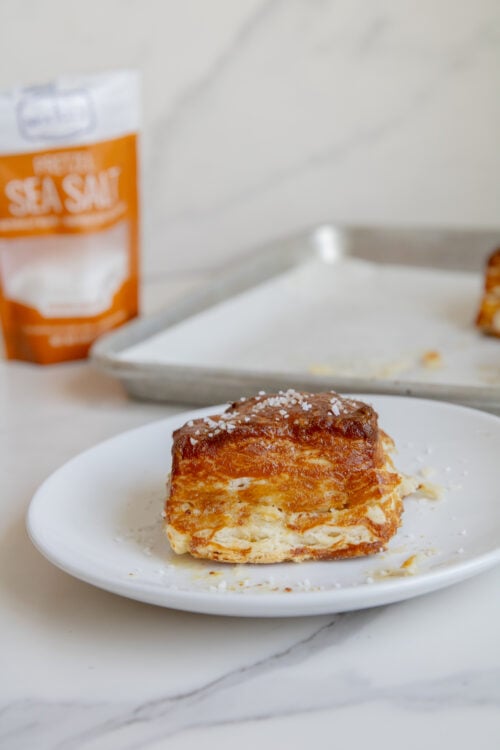
Pretzel Biscuits
Video
Ingredients
Biscuits
- 2 ½ cups all-purpose flour 313 grams spooned and leveled, plus more for your hands and work surface
- 1 tablespoon baking powder 12 grams
- ½ teaspoon baking soda 3 grams
- 1 teaspoon salt 6 grams
- ½ cup unsalted butter 113 grams cubed and very cold
- 1 cup buttermilk 240 grams cold
- 2 teaspoons honey 14 grams
- 2 teaspoons pretzel salt or flaky sea salt 6 grams
Pretzel Coating (if using baking soda)
- 3 tablespoons water 43 grams hot
- 1 ¼ teaspoons baking soda 7 grams
Pretzel Coating (if using lye)
- ¼ cup water 60 grams cold
- ½ teaspoon food-grade lye 2 grams weighed
Instructions
Make the pretzel solution
- Make the baking soda coating: stir the hot water and baking soda together in a small bowl until most of the baking soda dissolves. Set it aside.
- If using lye instead: *PUT ON GLOVES, eye protection, and make sure your hair is pulled back*. Pour the cold water into a small glass or stainless steel bowl, then add the lye and stir gently until fully dissolved. Set it aside.
Make the biscuits
- Line a large baking sheet with parchment paper.
- In a large bowl, whisk the flour, baking powder, baking soda and salt together.
- Add the cold butter and cut it in with a pastry cutter, or your hands, until the mixture looks like coarse crumbs.
- Make a well in the center. Pour in 1 cup (240 grams) of the buttermilk and drizzle the honey over it. Gently fold with a spatula just until the dough starts to come together. It will look shaggy, with some dry crumbs and wet spots.
- Turn the dough and any loose crumbs out onto a well-floured surface. With floured hands, gently press it together and flatten it into a ¾-inch-thick rectangle. The dough will be sticky, so keep extra flour close by.
- Fold one short side into the center, then fold the other side over it like a letter. Rotate the dough 90 degrees and flatten it back into a ¾-inch-thick rectangle. Repeat the fold and turn two more times, then flatten it one last time to ¾ inch thick.
- Cut out biscuits with a 2 ½- or 3-inch biscuit cutter, pressing straight down without twisting. Gather and re-roll the scraps until all the dough is used. You should have 10 biscuits. Arrange the biscuits on the prepared baking sheet so they are touching.
- Freeze the biscuits, uncovered, for 30 minutes. While they chill, place a rack in the upper third of the oven and preheat to 425°F.
- Stir the pretzel coating once more, then brush it generously over the entire top of each biscuit. It is fine to have a little bit left over.
- Sprinkle pretzel salt on tops of the biscuits.
- Bake for 18 to 20 minutes, until the tops are deep golden brown.




Rate This Recipe
What did your think?